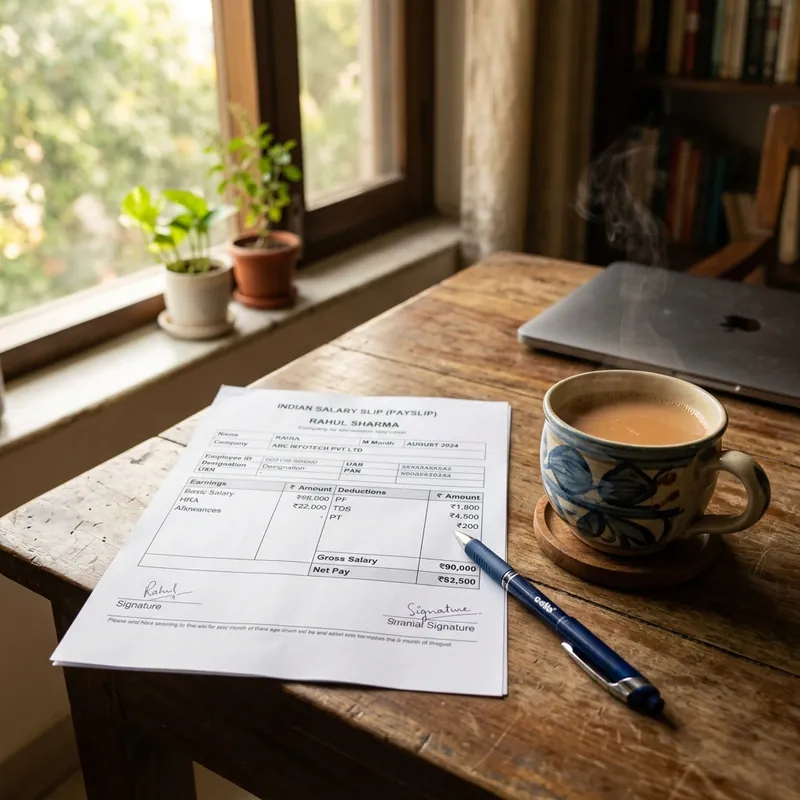
How to Save Income Tax on Salary: 7 Legal Ways to Keep More of Your Money

How to Save Income Tax on Salary: 7 Legal Ways to Keep More of Your Money

Every month, a chunk of your salary disappears before it even reaches your account. TDS — Tax Deducted at Source — is your employer handing over a portion of your income directly to the government on your behalf.

The good news: the Income Tax Act is filled with legal ways for salaried employees to reduce this deduction. Some of them require planning, some require paperwork, and a few just require knowing the rules.

Here are the most effective strategies, in order of impact.

1. Choose the Right Tax Regime First

Before anything else, decide which regime you're using. The Old Regime allows most of the deductions below. The New Regime doesn't — but has lower slab rates and zero tax up to ₹7 Lakhs.

Run the numbers for your specific salary and deductions. If your total deductions (80C + HRA + Home Loan interest + 80D) add up to more than ₹3.75 Lakhs, the Old Regime likely saves you more. Below that, the New Regime usually wins.

Our Income Tax Calculator compares both regimes side-by-side in under 2 minutes.

2. Maximize HRA — House Rent Allowance

If you live in a rented house and your employer pays you an HRA component, this is often the biggest tax saver available to salaried employees — sometimes exceeding even Section 80C.

The exempt HRA is the lowest of these three:

  • Actual HRA received from employer
  • Actual rent paid minus 10% of basic salary
  • 50% of basic salary (if you live in metro) or 40% (non-metro)

Example: Ravi lives in Pune (metro), basic salary ₹6 Lakhs/year, HRA ₹2.4 Lakhs/year, actual rent paid ₹2.16 Lakhs/year.

  • Actual HRA received: ₹2,40,000
  • Rent paid minus 10% of basic: ₹2,16,000 − ₹60,000 = ₹1,56,000
  • 50% of basic: ₹3,00,000

Exempt HRA = lowest = ₹1,56,000. This ₹1.56 Lakhs is subtracted from his taxable income.

Important rules:

  • Keep your rent receipts. If annual rent exceeds ₹1 Lakh, you need your landlord's PAN number.
  • You can legally pay rent to your parents and claim HRA — your parents must declare that rent as their income.
  • You cannot claim HRA if you own the house you're living in.

3. Fully Utilize Section 80C (₹1.5 Lakhs)

Section 80C is available in the Old Regime and allows up to ₹1.5 Lakhs to be deducted from your taxable income. Most salaried employees have some 80C already covered through EPF — check your payslip.

Best 80C options for salaried employees:

  • EPF: Already being deducted automatically
  • ELSS Mutual Funds: Best for wealth creation (3-year lock-in, market-linked returns)
  • PPF: Best for safe, tax-free guaranteed returns (15-year lock-in)
  • Home Loan Principal Repayment: Covered automatically if you have a home loan

Don't waste your 80C on endowment insurance policies. Buy term insurance for protection and keep 80C for genuine wealth-building investments.

4. Claim Section 24(b) — Home Loan Interest

If you have a home loan for a self-occupied property, you can deduct up to ₹2 Lakhs per year of home loan interest from your taxable income under Section 24(b).

This is separate from 80C (which covers the principal repayment). You can claim both simultaneously.

For someone in the 30% tax bracket with ₹2 Lakhs in home loan interest: that's ₹60,000 in direct tax savings per year — more than the annual cost of many mid-range home loan amounts.

Note: This deduction is NOT available in the New Tax Regime. It's one of the key reasons people with home loans often find the Old Regime more beneficial.

5. Health Insurance Under Section 80D

Section 80D allows deductions for health insurance premiums paid for yourself, your spouse, your children, and your parents.

Who is insured Max Deduction
Self + spouse + children (below 60) ₹25,000
Self + spouse + children + parents (below 60) ₹50,000
Self + spouse + children + parents (above 60) ₹75,000
Self + spouse + children + parents (both senior citizens) ₹1,00,000

Health insurance isn't just a tax saving tool — it's a genuine financial necessity that most Indian families should have regardless of the tax benefit. The tax deduction is a bonus.

What many people miss: if you pay your parents' health insurance premiums, those premiums qualify under 80D even if your parents are not financially dependent on you.

6. NPS — The Extra ₹50,000 Deduction

National Pension System (NPS) offers an additional ₹50,000 deduction under Section 80CCD(1B) that is over and above the ₹1.5 Lakh 80C limit.

If you're in the 30% bracket, this additional ₹50,000 saves you ₹15,600 in taxes. That's a significant incentive.

The trade-off: NPS money is locked until retirement (age 60). You can withdraw 25% of your own contributions under specific circumstances before 60, but 40% of the corpus must be used to buy an annuity at retirement (which gives you regular pension income).

NPS Tier-1 is the tax-saving account. NPS Tier-2 has no lock-in but no tax benefit.

Who should consider NPS?

  • Salaried employees in the 20% or 30% tax bracket
  • People who want a disciplined retirement saving that they genuinely won't touch
  • Those who have already maxed out 80C and are looking for additional deductions

7. Restructure Your Salary Components

This one requires talking to your HR, but it can be surprisingly effective for reducing your TDS without changing your take-home amount.

Several salary components are tax-free (or partially exempt) under the Old Regime:

Leave Travel Allowance (LTA): Exempt for actual travel costs (economy class train or air tickets) for travel within India, twice in a block of 4 calendar years. The travel must be real — you need to submit actual tickets.

Food Coupons / Meal Allowance: Up to ₹50 per meal, twice a day, for up to 22 working days a month = ₹2,200/month tax-free. Many companies offer this via Sodexo or similar vouchers.

Internet and Mobile Reimbursement: If your company reimburses actual internet or phone bills as part of CTC, this is tax-free (keep the bills for proof).

Newspaper and Book Allowance: Some companies offer small allowances for books and periodicals, which are tax-exempt if actually spent and receipts submitted.

The restructuring approach: Work with HR to convert some of your "special allowance" (fully taxable) into these exempt components. Your CTC stays the same, but more of it arrives tax-free.

This isn't applicable at every company — some HR departments are rigid about CTC structure — but if your company offers a Flexible Benefit Plan, use it.

Putting It All Together: An Example

Let's say Priya earns ₹15 Lakhs CTC. Here's how her taxable income breaks down with proper planning:

Component Amount Tax Treatment
Gross Salary ₹15,00,000 Fully taxable initially
Standard Deduction −₹50,000 Automatic for salaried
HRA Exempt −₹1,80,000 Based on rent paid
Section 80C −₹1,50,000 ELSS + EPF
Section 80D −₹25,000 Health insurance
Section 80CCD(1B) NPS −₹50,000 Additional NPS
Home Loan Interest 24(b) −₹1,20,000 Home loan
Net Taxable Income ₹9,25,000

Without planning: Priya would be taxed on nearly ₹14.5 Lakhs (after standard deduction). With planning: She's taxed on ₹9.25 Lakhs — a reduction of over ₹5 Lakhs in taxable income.

At 20–30% effective rates, that's ₹1–1.5 Lakhs in actual tax saved per year. Over a career, this compounds into a significant amount.


👉 Calculate your tax after applying these deductions Our Income Tax Calculator lets you enter your salary and all deductions and instantly shows your tax under both regimes. Find out exactly how much you can save.


Quick FAQs

1. What if my employer doesn't offer HRA?

If HRA is not part of your salary structure, you cannot claim it — HRA is a salary component, not a standalone deduction. However, if you pay rent, you may be able to claim a deduction under Section 80GG (for self-employed or salaried without HRA), subject to conditions.

2. Can I change my tax regime mid-year?

No. Once you inform your employer of your regime choice at the start of the year, the TDS is deducted accordingly. However, at the time of filing your ITR, you can switch — but only if you don't have business income. Salaried employees can switch at filing time.

3. I work from home. Can I claim home office deduction like in the US?

No, Indian tax law doesn't have a standard home office deduction for salaried employees under the Old Regime. This type of deduction is more relevant for self-employed individuals who can claim actual office expenses.

4. My company deducted too much TDS. Can I get a refund?

Yes. When you file your ITR, if your actual tax liability (after all deductions) is less than the TDS your employer deducted, the excess TDS is refunded by the income tax department — typically within 2–4 months of filing.

Disclaimer

Tax laws change with each budget. Deduction limits and rules in this article reflect the current financial year's provisions. Consult a CA or tax professional for personalized advice.

Advertisement
E

About EasyLedger

EasyLedger is an independent project built to make Indian finance simple. Our content is AI-assisted and carefully reviewed. We are not SEBI-registered advisors — our tools and guides are educational starting points. Read our full disclaimer.

← Previous Guide Section 44ADA: How Indian Freelancers Legally Pay Tax on Half Their Income
Next Guide → The Income-Tax Act, 2025: 5 Key Changes in India's New Tax Law (Effective 2026)

Join the Conversation

Comments are active! Drop a message below to join the discussion.