You walk into an electronics store to buy a new smartphone. The price tag says ₹35,000. It's a bit steep to pay all at once, and you don't want to wipe out your bank balance.
Just as you're about to walk away, the salesperson suggests: "Sir, EMI pe le lo. Credit card nahi chahiye, pre-approved EMI Card se 2 minute mein ho jayega. No-Cost EMI option bhi hai!"
It sounds incredibly convenient. You get the phone today and pay just ₹3,888 per month for 9 months. But what exactly is an EMI card? Is it really "No-Cost"? Or is there a catch that will hurt your wallet and CIBIL score later?
Let’s break down the reality of EMI cards in plain, jargon-free Hinglish.
What is an EMI Card? (EMI Card Kya Hai?)
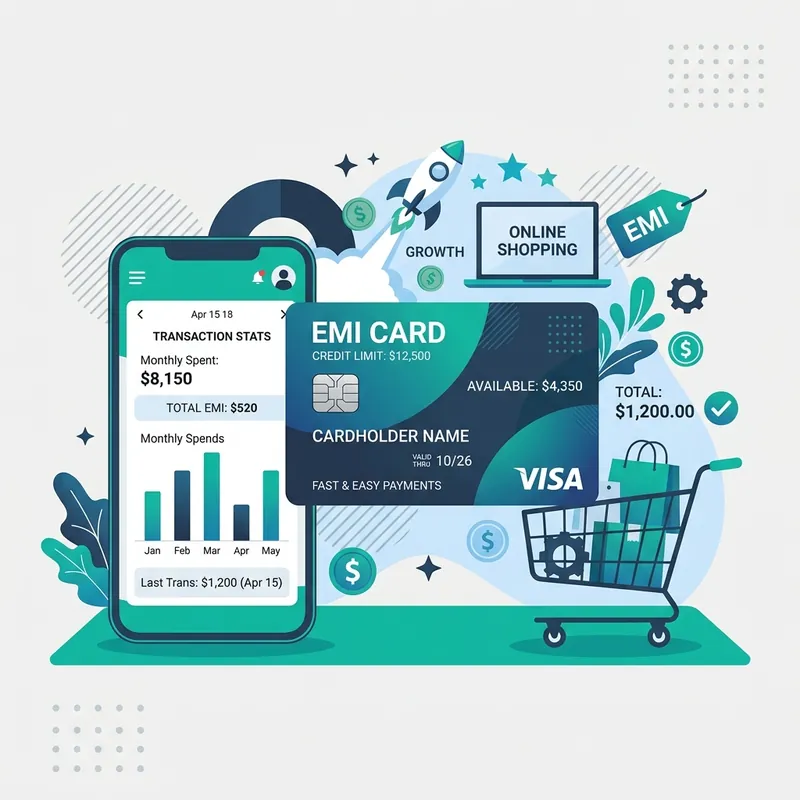
An EMI Card (such as the Bajaj Finserv Insta EMI Card, HDFC EasyEMI Card, or SBI Card EMI facility) is a digital or physical card that comes with a pre-approved credit limit specifically designed for shopping.
Unlike a regular Credit Card, which you can use to pay for dining, petrol, or cash withdrawals, an EMI card is built for one main purpose: to instantly convert your purchases into Equated Monthly Installments (EMIs) at checkout.
Key Features:
- Pre-approved Limit: Typically ranges from ₹50,000 to ₹2,00,000 depending on your income and credit profile.
- No Credit Card Required: It serves as an alternative for people who don't qualify for or want a standard credit card.
- Partner Network: You can use it across thousands of online websites (Amazon, Flipkart) and offline retail stores (Croma, Reliance Digital).
- Flexible Tenures: You can choose to pay back the amount over 3 to 24 months.
How "No-Cost EMI" Really Works: The Math Behind the Illusion
Most people sign up for EMI cards to take advantage of No-Cost EMI schemes. The advertisements promise "zero interest and zero down payment."
But as the Reserve Bank of India (RBI) has repeatedly pointed out, there is no such thing as a free lunch in banking.
Under RBI rules, banks and financial institutions are strictly prohibited from offering true 0% interest loans. If there is interest, it must be shown. So, how does "No-Cost EMI" operate?
The Merchant Discount Model (Realistic Example)
Let’s say Amit wants to buy a laptop worth ₹40,000 using a 6-month No-Cost EMI card. The interest rate charged by the card provider is 16% per annum.
- The Hidden Discount: Instead of charging Amit interest on top of ₹40,000, the laptop manufacturer/store offers an upfront discount equal to the interest amount (which is roughly ₹1,850 in this case).
- The New Principal: The invoice shows the laptop price as ₹38,150 (₹40,000 − ₹1,850).
- The Interest Charge: The EMI card issuer lends Amit ₹38,150 and charges 16% interest over 6 months.
- The Final Split: By the end of 6 months, Amit pays exactly ₹40,000 in total.
On paper, Amit paid no extra interest. But here are the hidden costs that most salespeople won't mention:
- Processing Fee: Almost all EMI cards charge a processing fee (typically ₹99 to ₹199) per transaction.
- GST on Interest: You must pay 18% GST on the interest component of your EMI every month. Even though the store discounted the interest, the government still taxes the interest generated by the bank!
- Foreclosure Fees: If you decide to pay off the remaining balance early to close the loan, you might be charged a foreclosure fee of 2% to 3% of the outstanding amount.
Hard Statistics: The Consumer Credit Boom in India
Indians are buying on credit like never before. According to recent data from the RBI:
- Credit Growth: Micro-loans and consumer durable loans (including EMI cards and BNPL digital limits) grew by over 24% year-on-year in 2025/2026.
- The Gen-Z Shift: Over 60% of digital EMI card transactions are driven by young professionals under the age of 30, purchasing smartphones, smart TVs, and vacation packages.
- Late Payment Surge: With easy access to credit, default rates on small-ticket personal loans (under ₹50,000) have also ticked upward, prompting the RBI to issue strict guidelines on credit transparency.
3 Big Mistakes to Avoid with EMI Cards
While these cards are great for managing cash flow, they can quickly turn into a debt trap if misused. Here are three major pitfalls:
1. The Overspending Trap
When you see a phone costing ₹40,000, your brain hesitates. But when you see "₹4,444 per month," it feels cheap. This psychological trick leads many to buy things they don’t actually need or can’t afford. If you have 4 different EMIs running simultaneously, they will eat up a massive chunk of your salary.
2. Missing the Auto-Debit Date (ECS Failures)
When you get an EMI card, you must link it to your bank account for auto-debit (NACH mandate). If your EMI date is the 5th of the month, and your account does not have enough balance, two bad things happen:
- Late Payment Fee: The card issuer will charge you a hefty penalty (typically ₹350 to ₹500 + GST).
- Bank Bounce Charges: Your own bank will charge you a NACH/ECS bounce fee (another ₹250 to ₹500). A single missed ₹2,000 EMI can cost you an extra ₹1,000 in penalties!
3. Damaging Your CIBIL Score
Every EMI card is linked to a consumer loan reported to credit bureaus like CIBIL. If you miss even one payment or delay it by a few days, your credit score will drop significantly. A low credit score makes it extremely difficult to get a home loan or car loan in the future.
Pro Tips for Smart EMI Card Users
- Follow the 50/30/20 Rule: Ensure your total monthly EMIs across all cards and loans do not exceed 20% of your take-home salary.
- Keep a Buffer: Always keep a buffer of at least one EMI amount in your auto-debit bank account to avoid costly bounce charges.
- Skip Depreciating Assets on Credit: Try to avoid buying apparel, dining out, or holiday trips on EMI. Buy them only when you can pay in full. Save the EMI card for essential consumer durables like laptops or washing machines.
👉 Planning a major purchase?
Before you swipe your card, check exactly how your repayments will be divided between principal, interest, and processing fees. Use our Free EMI Calculator to see the full month-by-month repayment schedule!
Final Thoughts
An EMI card is a double-edged sword. If used responsibly to buy necessary appliances or work tools without breaking your monthly savings, it is an excellent financial utility. However, if used to fund an impulsive lifestyle, it will erode your savings, lock you into monthly liabilities, and drag down your CIBIL score.
Remember, jitni chadar ho, utne hi paanv pasarne chahiye!
Quick FAQs
1. Does applying for an EMI card affect my CIBIL score?
Yes, when you apply for an EMI card, the lender does a "hard inquiry" on your credit profile. This might temporarily drop your CIBIL score by a few points. However, if you make all your payments on time, your score will steadily improve.
2. What is the difference between an EMI Card and a Credit Card?
A Credit Card is a revolving credit line that lets you spend on any category, withdraw cash, and gives you a 30-to-45-day interest-free period before you must pay the bill in full. An EMI Card is specifically designed to convert single retail purchases into structured, fixed monthly loans at the point of sale.
3. Can I close my EMI card at any time?
Yes. You can request closure of your card after paying off all outstanding EMIs and fees. Ensure you get a "No Objection Certificate" (NOC) or a closure confirmation email from the issuer so your credit profile reflects it as closed.
4. Is the processing fee on No-Cost EMI refunded if I return the product?
Generally, no. Even if you return the item and the merchant refunds the product cost, the bank or card issuer will not refund the one-time processing fee or the GST already charged on the transaction.
Disclaimer: EMI cards and loan conversions are subject to terms and conditions set by individual lenders. Always read the Most Important Terms & Conditions (MITC) before registering.